4:3 Aspect Ratio Calculator
Need to find the right size for a 4:3 project? Just enter the width or height in pixels below, and this calculator will instantly find the other dimension for you.
What is the 4:3 Aspect Ratio?
The 4:3 aspect ratio is a rectangle that's a little wider than it is tall. For every 4 inches across, it's 3 inches tall. Old TVs and computer monitors used this shape, so it can give a cozy, old‑school feeling to videos and photos.
Today, most TVs and phones use a wider 16:9 ratio, but 4:3 is still very common. Many tablets, including Apple's iPads, have 4:3 screens because the shape feels natural for reading, browsing the web, and looking at photos. That means you might be using a 4:3 screen every day without even knowing it!
Calculating 4:3 Pixel Size
This calculator makes it super easy to get the exact 4:3 pixel size for any job.
- For video: Make old‑style videos that fit perfectly in a 4:3 player.
- For photos: Crop your images to the classic shape without squishing.
- For design: Start your presentation slides or digital art with the right proportions from the beginning.
Common 4:3 Resolutions
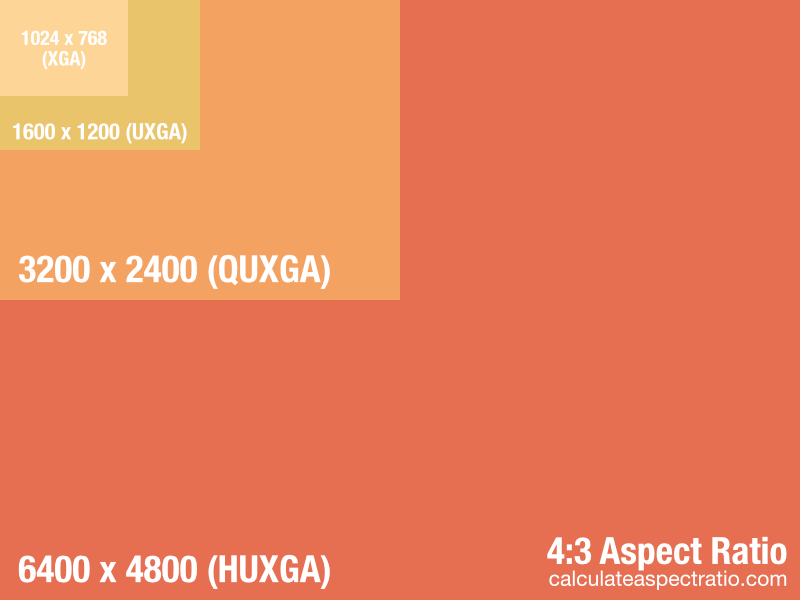
Here is a list of common 4:3 resolutions, from smallest to largest:
- 160 x 120 (QQVGA)
- 320 x 240 (QVGA)
- 640 x 480 (VGA)
- 800 x 600 (SVGA)
- 1024 x 768 (XGA)
- 1152 x 864 (XGA+)
- 1280 x 960 (SXGA-)
- 1400 x 1050 (SXGA+)
- 1600 x 1200 (UXGA)
- 2048 x 1536 (QXGA)
- 3200 x 2400 (QUXGA)
- 4096 x 3072 (HXGA)
- 6400 x 4800 (HUXGA)
Those long names (like VGA or XGA) are just old computer monitor labels. Don't worry about remembering them; the numbers are what matter.
While the most popular screen resolution today is 1920x1080 (16:9), many classic monitor sizes like 1024x768 are still used in specific applications and on some tablets.
Where You Still See 4:3 Today
You might think 4:3 is only for old stuff, but it's still everywhere:
- iPads and tablets: Apple's standard iPad screen is 4:3 because it feels like holding a book. Great for drawing, reading, and schoolwork.
- Retro games and videos: Classic video game consoles and old TV shows were designed for 4:3. Many people keep this shape to enjoy them the way they were meant to be seen.
- Some digital cameras: Certain medium‑format and compact cameras shoot in 4:3, giving your photos a slightly taller, more intimate look than 3:2.
So even in a world of ultra‑wide screens, the simple 4:3 rectangle still has a comfy home in our pockets and backpacks.
Converting 4:3 to 16:9 (and Back)
Old 4:3 footage and new 16:9 screens are different shapes, so one of them has to give. There are three ways to convert 4:3 to 16:9, and each has a trade-off:
- Pillarbox (keep everything): Keep the 4:3 image and add black bars on the left and right. Nothing is lost, but the screen is not fully filled.
- Crop (fill the screen): Zoom until the frame is filled. The top and bottom of the 4:3 image get cut off.
- Stretch (avoid this): Stretching 4:3 to 16:9 makes everything look wide and unnatural.
To convert dimensions mathematically, keep one side fixed and recalculate the other. For example, a 4:3 image that is 1024 x 768 becomes 1024 x 576 if you keep the width and match a 16:9 height (1024 ÷ 16 × 9 = 576). Keeping the height instead gives 1365 x 768. Here is a quick conversion table:
- 640 x 480 (4:3) → 640 x 360 (16:9)
- 1024 x 768 (4:3) → 1024 x 576 (16:9)
- 1440 x 1080 (4:3) → 1440 x 810 (16:9)
- 1600 x 1200 (4:3) → 1600 x 900 (16:9)
- 2048 x 1536 (4:3) → 2048 x 1152 (16:9)
Going the other way — 16:9 to 4:3 — works the same way, just with the 4:3 formula (width ÷ 4 × 3). Use the calculator above to convert any exact size.